
What IS Rest?
Have we got it wrong and why doesn’t it solve chronic fatigue?
In this blog, I’ll be looking at some things we think of as rest but really aren’t, some things we DON’T think of as rest but can be, and what actually helps with fatigue.
When we think of rest, we think of doing very little or nothing - sleeping, having a “couch day” perhaps, reading and drinking cups of tea with our feet up - things like that.
In the world of chronic illness, rest is hailed as necessary on a regular basis and might mean a day (or days) in bed or taking naps during the day etc. - either as a kind of preventive measure (as part of pacing) - or through having no choice in the matter, due to a flare-up or “crash”.
However, no amount of this kind of physical resting fixes chronic fatigue - not because it can’t be fixed, but because physical exertion doesn’t cause it (see my other blogs/videos if you haven’t already, to learn more about that).
Therefore, is the idea that it is so necessary just a bullshit rhetoric peddled by those who don’t understand these conditions as much as they think - or say - they do?
And, is there another kind of rest that could actually help chronic fatigue (and other symptoms) in a real way?
Well, when we look at the cause as being a build up of stress within the body, we have to think of it in relation to the mind-body connection.
Our minds and sensory systems need rest more than our bodies do, especially in this day and age of over-stimulation.
This means many of us probably rest too much but in the wrong ways, meaning not moving and doing enough with our bodies - but at the same time - never let our minds stop…constantly consuming content without due regard to what kind of input we are allowing ourselves to be exposed to.

Here are some examples:
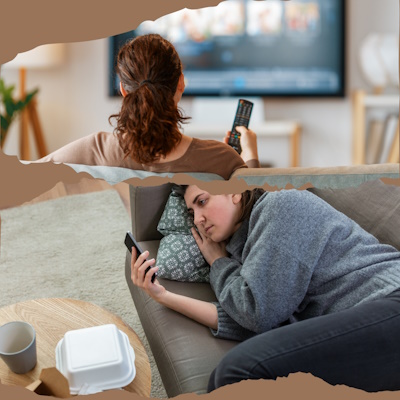
Lying in bed or on the couch, trying to rest, but doomscrolling - absorbing other peoples’ negativity and anger, or comparing ourselves to those with perfectly curated feeds and allowing ourselves to feel envious of their success or freshly decorated, tidy homes, or how happy they look spending time with their families… Relatable?
Or how about, again, on the couch or in bed but catching up on your soaps. These are TV programmes that are designed to feed you stressful drama and negativity. You might think “it’s just a tv show, it doesn’t affect me”, but it fucking does! If you are observing something and it makes you feel in any way negative, it is affecting you. And, if you don’t do something to shift that feeling, it will continue to affect you until you do.
Same with the News. Do you sit down with a nice cup of tea and watch the news before you go to bed?...then wonder why you struggle to sleep…you know, after you’ve allowed your consciousness to be filled with the stuff of nightmares?
Do you know that there will be far more positive, than negative, things happening around the world on a day to day basis that should be newsworthy, but these aren't the things being reported..
Instead, we are fed the fear and negativity, constantly and deliberately.
This has an effect on the nervous system when consumed, especially on a regular basis.
Here are some examples:
Lying in bed or on the couch, trying to rest, but doomscrolling - absorbing other peoples’ negativity and anger, or comparing ourselves to those with perfectly curated feeds and allowing ourselves to feel envious of their success or freshly decorated, tidy homes, or how happy they look spending time with their families… Relatable?
Or how about, again, on the couch or in bed but catching up on your soaps. These are TV programmes that are designed to feed you stressful drama and negativity. You might think “it’s just a tv show, it doesn’t affect me”, but it fucking does! If you are observing something and it makes you feel in any way negative, it is affecting you. And, if you don’t do something to shift that feeling, it will continue to affect you until you do.
Same with the News. Do you sit down with a nice cup of tea and watch the news before you go to bed?...then wonder why you struggle to sleep…you know, after you’ve allowed your consciousness to be filled with the stuff of nightmares?
Do you know that there will be far more positive, than negative, things happening around the world on a day to day basis that should be newsworthy, but these aren't the things being reported..
Instead, we are fed the fear and negativity, constantly and deliberately.
This has an effect on the nervous system when consumed, especially on a regular basis.
How about something a bit different…
You’ve been having a stressful time and decide that a nice relaxing drink with your best friend is just what you need. You order a glass of wine and head to a quiet corner of the pub and look forward to having a catch up and putting the world to rights.
But it gradually gets busier; there is a slot machine in your peripheral vision, flashing as well as making noise, whether someone is playing it or not. You’re trying to focus on what your friend is saying but other people are splitting your limited attention span - the quiet and tense looking couple in your eye line, the loud arrogant guy talking business on the phone, the group of lads that shout “wayhay!” when the poor girl behind the bar drops a glass, WhatsApp notifications from your other half who says they’re hoping you’re having a good time but secretly wondering if you’ll be on your way home soon… on top of twenty other more minor assaults on your senses.
You feel like you should be enjoying yourself and relaxing but you are feeling tired and irritable and just want some peace and quiet.
That’s your guidance right there - that want and need for peace and quiet.
And when input from others or from various forms of media causes feelings of stress, irritability, frustration, negativity etc,
that’s also guidance.
How do you honour that?
DO you honour that?
Do you ever give your sensory (and nervous) system a damn break, apart from when you’re alseep?
And is it enough of a break? Do you even manage to get enough sleep?
How much do you actually let yourself switch off?
And when you are switched on, doing something that is busying your mind, is it in a healthy, stimulating way, or is it the kind of input I’ve mentioned above?
Because, this healthy kind of stimulation I’m talking about is a way of resting while being switched on, in certain ways.
By this, I mean, being engaged in activities which need your focus but you truly enjoy and/or become absorbed in.
This might be a creative activity or learning a new skill or subject; it could be watching a feel-good movie or tv show that makes you laugh out loud; it could be a fascinating conversation with someone (in a quiet and peaceful environment!); it could be a game of tennis, playing the guitar or practising baking the perfect scone.
The point is that, if it captivates you and it is something that meets your needs, it could well do the job that you have always delegated to physical rest.
This is because it is likely to give you energy and make you feel good.
Meeting your needs helps you to feel emotionally safe and when you are in this place, your nervous system can calm down - you feel relaxed. It’s a form of switching off certain parts by being switched on in the right way.
One of the other ways we are told to rest, especially these days, is to meditate. It has become one of the things we are told we “should” do.
So, if you don’t sit in a quiet room, focusing on your breath, listening to plinky plonky fucking music (with or without someone softly telling you to imagine you’re in a field or walking down a path or being bathed in golden light) for twenty minutes every morning before drinking a cup of lemon water and sending white light and unconditional love to every being you’ve ever come across, you’re doing life wrong… *eye roll*
Now…if that shit works for you then brilliant, keep doing what works!
But, if you struggle to meditate, I want you to know that’s okay and very common!
And, I’m about to tell you why you might be struggling and offer some alternatives to doing it the above way, that you may just be able to get on board with.

Meditation IS brilliant.
BUT - if your mind feels like it has been going a million miles an hour for years or as long as you can remember, you’re not going to be able to just bring it to a stop suddenly.
And if you try, you’re likely to fail quickly and get really frustrated and build a negative association with, and all kinds of resistance around, doing it. I know - I’ve been there.
If you could go from overthinking to suddenly not thinking in a split second, there would be no issue. The fact that this is nigh on impossible is part of the problem in the first place.
Even if you do manage to create some space in there, your thinking brain is going to freak out and find all kinds of other shit to fill it with and, so, in the beginning, trying to meditate can actually make feelings of anxiety and being on edge even worse.
And the pressure of trying to make it work, mixed with feelings of failure just compounds all of this.
So, to begin with, it can often be better to switch focus from your racing thoughts to the kinds of activities I have mentioned above - positive, enjoyable things that are engaging and do take your focus.
Doing things to meet your needs is what your emotional brain wants you to do anyway, therefore, this will naturally help to reduce the need for symptoms like overthinking and anxiety to appear.
This will then make it easier to practise meditation if you want to, as one of a variety of ways to rest effectively.
However, you may still find it difficult as it recreates that space that your mind wants to fill so other methods may be more helpful and enjoyable.
Different types of meditation:
There are many ways of getting into a meditative state and this is going to be a short list, designed more to spark some ideas within you, than to be an exhaustive one.
Writing - journaling about your thoughts, feelings or a problem you have, without thinking about what you’re writing or worrying about spelling and grammar etc. and, instead, just allowing the words to flow from you. You may be surprised at the words and wisdom that land on the page and how much this reduces your overthinking or anxiety about what you’ve written about. It can often even give you the clarity on the situation or subject that you’ve been craving.
Drumming - I used to teach drums, including some basic hand-drumming to some kids with behavioural issues and it was one of the few things that some of them would engage in. Not only that, but one kid in particular - who was normally highly strung and resistant to doing anything teachers wanted him to do - would love sitting playing simple repeating rhythms and would go into a zone where he seemed to switch off to everything around him and relax. The combination of starting by engaging fully with what he was doing, the rhythm, the vibration and his connection to the drum with his bare hands clearly worked to bring him out of his head and into his body and a place he could temporarily feel safe.
Being in nature - mindfully observing nature, without trying to meditate; getting lost in Autumn colours, the flowing water of a stream, the sound of rain, falling of snow, or the flickering flames of a fire.

These are all ways of accessing that meditative state which allows all of the overthinking and feeling of being “switched on” to slow right down, meaning you are reducing the momentum of all of that.
It’s about sitting in that place where you become almost unaware of what is going on around you - somewhere between your mind and your body - but are tapping into a connection to something more than both of them - to the Universe/God/Source/your Higher Self or Inner Being/humanity as a whole - whatever fits your beliefs or how you see the world.
The important thing to know is that we are not always resting when we think we are and there are things we often don’t see as being restful that can be.
The trick is to know when you need to switch off from sensory stimulation, and when you need to do something that stimulates you in the right way.
This is all part of getting to know you and how you really work, after a lifetime of trying to fit in, people-pleasing, doing what you think others think you should do, listening to all those “shoulds” in your head that come from family, friends, your community, society as a whole.
Learning to turn down all of that noise and tune into yourself is the only way to find peace and follow what is right for you.
This uncovers your innate self-confidence that has been hidden underneath everyone else’s shit and empowers you to keep doing what is right for you first and foremost, because you feel in your bones that it’s fucking time you did.
This is how to:
- get out of fight or flight mode,
- quiet your mind and your nervous system,
- reduce your anxiety and your physical symptoms, regain your energy and feel like you again (or for the first time!)
If you want a step-by-step guide on what to do to achieve this, my low-cost online course is for you.